

Constexpr Isn't Just for Array Sizes—Here's How It Eliminates Entire Runtime Systems

C++’s constexpr keyword tells the compiler to evaluate expressions at compile-time rather than runtime. Since C++11, developers have used it for straightforward optimizations: computing array sizes, generating lookup tables for mathematical constants, validating template parameters, and eliminating trivial calculations from hot loops. A typical use might precompute a factorial table or evaluate simple formulas like 2 * PI * radius when the radius is known at compile-time. These applications save a handful of cycles here and there—useful, but hardly revolutionary.
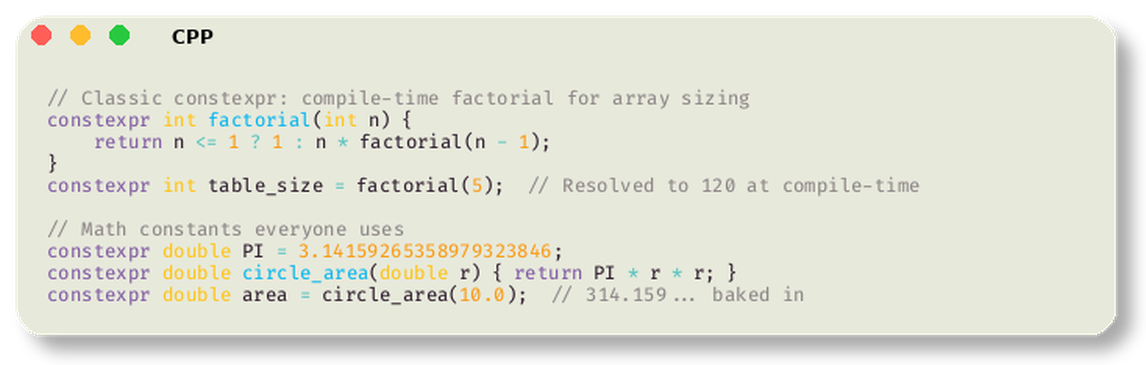
Most codebases treat constexpr as a minor optimization tool for mathematical utilities and configuration constants. The standard library leverages it in std::array, compile-time arithmetic, and type traits, but these remain fairly pedestrian use cases. The real question is whether constexpr can move beyond eliminating trivial arithmetic and start removing entire categories of runtime work in latency-critical systems.
